
How to Save Time as a Product Owner With 7 Simple Habits

POV: You’re a Product Owner When Your 40 Hour Week Feels Like 60
Someone just booked a meeting into the last free spot your calendar had for the next three weeks.
Your inbox fills up with stakeholder requests faster than you can sort them.
And of course, everything that people send you comes with the same level of urgency.
You’re trying to ship good work, protect your team from stress, keep the backlog alive, answer a dozen quick questions, and somehow find a way to save time as a Product Owner while your week keeps stretching into something that feels more like 60 hours.
If that sounds familiar, good. This article is for you.
The Real Reason You Don’t Have Time as a Product Owner
Most Product Owners we talk to feel the same way: they’re constantly busy, constantly in motion, constantly responding to something. The week is packed with meetings, messages, alignment rounds, updates, and questions. On paper it looks like work. In reality it barely creates progress.
And that’s the real trap. The problem is: We get rewarded for output. For activity. For being available. For keeping things moving. Even if that movement doesn’t lead anywhere valuable. The system we work in teaches us to stay busy instead of teaching us how to be effective, because busy is easier to measure than impact.
Let Us Show You What Busy Looks Like
Busy means: Your days are full but nothing important gets done. You’re updating boards, writing tickets that will never be built, preparing documents nobody reads, answering questions that solve nothing. It feels productive in the moment, but it drains you over time. You end a week exhausted and still feel behind.
And that exhaustion is not just an inconvenience. It’s stress that builds up slowly. It’s frustration when your work feels reactive instead of intentional. It’s the sense that you’re always catching up, never leading. And that wears you down more than you think.
Please believe us when we tell you: Your time is too valuable for this kind of busy work. Your team needs clarity from you, not more Scrum meetings. Your stakeholders need decisions, not more documents. And your job is to strategically lead the product, not babysit the process.
Now Let Us Show You What Real Outcome Looks Like
You create impact when you talk to a customer and learn something useful. When a stakeholder call ends with a yes or no instead of “let’s revisit this next week”. Your team has what they need and can focus fully on your top priority without endless clarifications. And at the end of the sprint they ship something small but valuable, and you can point to an actual user who benefits from it.
We’re used to create output when we should actually focus on outcome.
Breaking out of this pattern isn’t about working faster or harder. It’s about choosing the work that actually moves the product forward. The good news is: you don’t need a new method or a new tool. You just need a few practical habits that help you to get rid of output-focused processes. And that’s where we’re heading next.
7 Simple Habits That Help You Save Time as a Product Owner
1. Give People Worse Versions of What They Want
Most requests are oversized. People ask for a deck, but what they really need is a decision. They ask for a requirements document, but they just want clarity.
Give them less. Start smaller.
A 3 minute Loom instead of a 20 minute presentation. A one pager instead of a full spec. A Slack message with three bullet points instead of an investigation and three meetings.
If they truly need more, they’ll ask. Most don’t. This alone can save you hours every week.
2. Define “Done” Before You Even Start Talking
This is really, really important. You should never have meetings where everyone casually talks for 45 minutes and leaves with nothing. Meetings don’t waste time because people talk too much. They waste time because nobody knows what the outcome should be.
So start every meeting with one sentence: “What do we need to walk out of this with?” A decision? A list of open questions? A final scope? Set it upfront. Your meetings will be shorter and you will have clear results that you can continue working with. And you avoid recurring meetings on the same topic.
3. Run One Brutal Clarity Session per Quarter
Every quarter, bring the team together and ask one question: “What are we doing that no longer matters?” Things die fast in product work. Kill the dead stuff before it kills your time.
We know it hurts if you already started working on something and put hours or energy into it. But “almost ready” is the biggest lie in software development. If it isn’t needed any longer, you have to stop it. So better do it now.
This prevents you from wasting time on projects nobody believes in anymore and makes room for the stuff that actually matters.
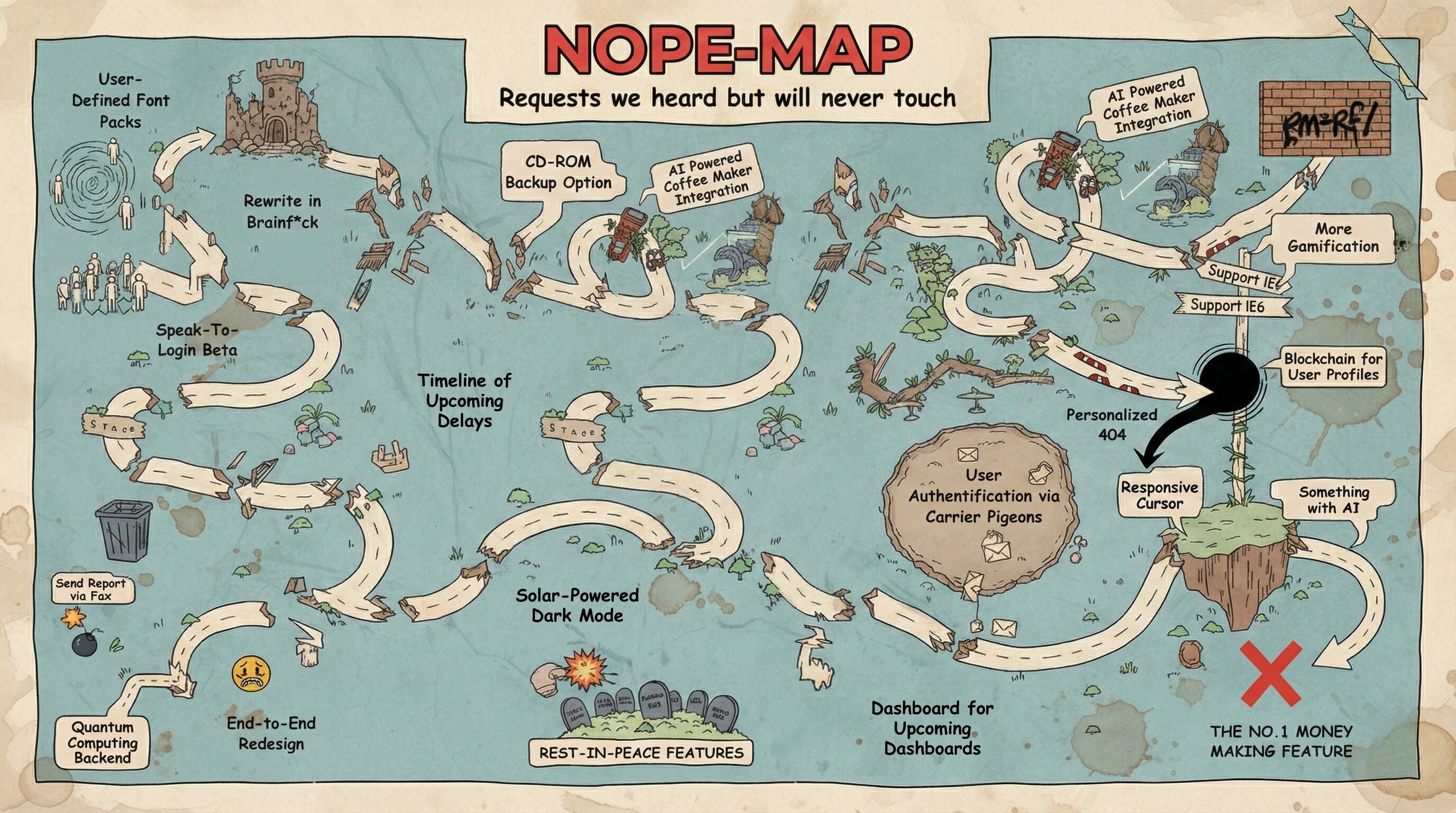
4. Create a Nope-Map
You have a roadmap? That’s great. What you need now is a "Nope-Map". The opposite of a roadmap. A simple list everyone knows with things that will never be prioritized unless something drastic changes. It kills 90 percent of repeated discussions that fill your week and keep you from actually working on something.
These are some examples of things that belong on the list:
- Very specific edge cases that only help 1 or 2 users
- Features that sound cool and look impressive, but don’t solve a real user problem
- Old ideas people bring up “just in case”
- Anything that has been rejected more than twice for a good reason
If you decided to not build it (now), make it visible. People stop pushing once they see it in writing.
Who should read this?
5. Stop Estimating Work That Doesn’t Matter
Stop story-pointing things you do not care about. Small UI tweaks, one-line changes, tiny improvements. Stop giving them story points. Stop debating them in refinement.
Drop them into a weekly quick wins bucket and let the team pick them up without ceremony. You save the admin time. The team saves the meeting time. Everyone wins.
6. Kill 80 Percent of Your Backlog
You have to be ruthless on that one. Your backlog is bloated. We haven’t seen it, but we bet it is. Everyone’s backlog is. A graveyard of old ideas, opinions, requests, and forgotten promises to customers who left years ago.
Go through it once and ask one question for every item: Would I fight for this if we had to build it next week?
If the answer is anything other than yes, delete it. No, we didn’t mean archive. Delete.
If you feel it’s cruel of us to say this in 7 lines, that’s a fair point. But we have a whole blog post about how you can clean up your backlog. Feel free to read that first, and come back for the rest later.
7. Automate One Annoyance Every Week
Don’t go big, you don’t need a company-wide AI plan. Don’t try to automate your entire workflow in one go. It will be outdated before you finish setup.
Don’t call it “automation initiative”, don’t schedule a vision meeting to design a perfect future state. Because that’s exactly how automation becomes another time sink instead of saving time.
The whole point of the tip is: Start tiny. Start practical. Automate something boring that annoys you every single week.
Here are some examples where we would start:
- Auto-generate your weekly status update
- Save a Jira filter for your most common search so you stop clicking through boards
- Or stop manually filtering Jira and use an AI tool for search
- Create a rule that moves all FYI or CC emails into a “Later” folder
- Auto-generate meeting minutes
- Give the input, but don’t write and format every Jira ticket yourself (there’s AI for that)
- Let AI split your epic into smaller stories
Small stuff only. And remember the number one rule: automation must not take longer than the task itself. Do this every week and in six months you’re a different Product Owner.
Start Small, But Start Now
Do you know what we hear second most after “I don’t have time”? It's “I don’t have time to do anything about it”.
It’s exactly the same as the person pushing a cart with square wheels who refuses the round ones because “they’re too busy” to try something new. We all laugh at that picture, but we do the exact same thing in product work.
We don’t ask you to spend the rest of the week on time-management. We suggest you pick one thing from this list that you want to change. Apply it this week. The difference shows up faster than you think. And when you’re ready, tackle the next one.
One Last Thing, If You Want to Go Beyond Good Habits
We know we said it’s not about a tool. And we mean that. If you haven’t learned to say “no” yet, no tool on the planet will save you time. Fix that first.
But once you have that foundation, we really believe that AI can help you to remove the repetitive work that fills your week. We don’t say this because it’s trendy. When you know exactly what problem slows you down, AI becomes a surprisingly powerful way to take care of it.
That’s why we built Product Copilot, an AI tool built specifically for product teams. It works inside the tools you already use and takes over the tasks that cost you hours every week. The boring stuff. The repetitive stuff. The things you shouldn’t be doing manually anymore.
As we are talking about time, we just want to share a few numbers:
On average, Product Copilot users save around 2 hours every week. That’s 100 hours a year. Two and a half full work weeks. Basically an entire sprint per person. If you use that time to ship something with your team or ask your boss for two and a half weeks of well-deserved extra vacation is up to you. And that's just the average time saved. Power users report saving more than 10 hours a week.
If you feel like an AI tool is not for you, that’s totally fine. There are many ways to save time. But please don’t fall into the “I don’t have time to try something new” trap. That’s the square-wheel mindset we talked about earlier. And it keeps you stuck exactly where you don’t want to be.
Did you pick where you want to start saving time?
Good. You’ve got this!